.

-
07June
Tears of joy and emotion
“... The pianist began the first movement (Molto moderato) with tender gentleness and a discreetly melancholic touch, but also with dignified tension, ending on a blissfully dreamlike phrase. This was followed by the slow second movement (Andantino) in F-sharp minor which surpassed all previous forms of expression, as climax of the work. Lee allowed its melodic beauty to blossom into full glory. After the lively Scherzo of the third movement the final movement (Allegro ma non troppo) was followed by long applause. Quite a few listeners had tears in their eyes: tears of joy and emotion.“location_on by Horst Hacker
September 10, 2021 - Memminger Zeitung location_on 8:00 AM - 9:00 AM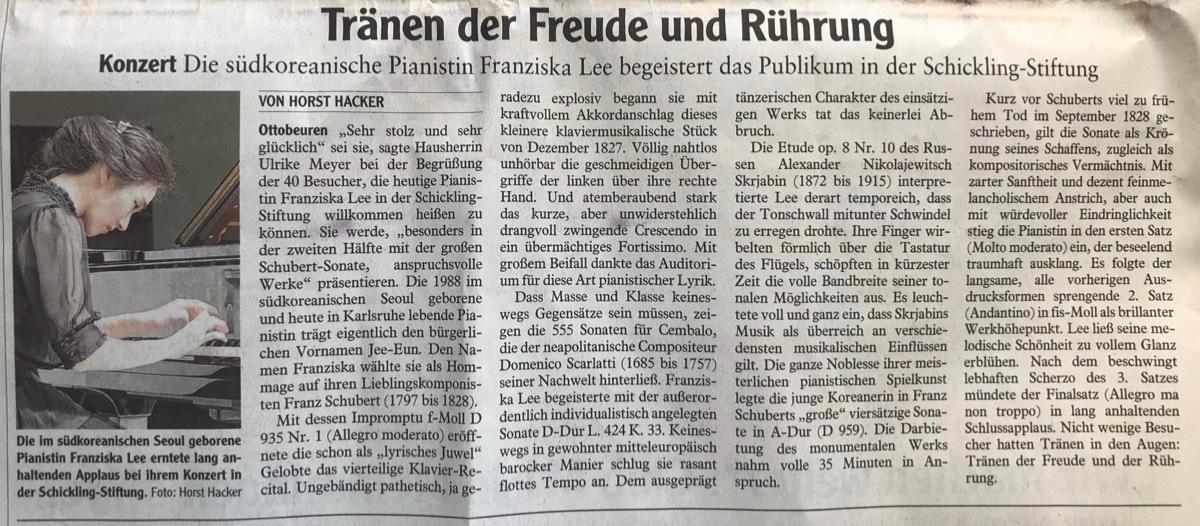 Concert - South Korean pianist Franziska Lee inspires the audience at the Schickling Foundation
Ottobeuren. In welcoming the forty guests the host Ulrike Meyer said she was "Very proud and very happy" to be able to introduce the present pianist Franziska Lee to the Schickling Foundation. "Especially in the second half with the great Schubert sonata. She will perform challenging pieces. The pianist who was born in Seoul, South Korea, in 1988 and now lives in Karlsruhe, actually has the first name Jee-Eun. She chose the name Franziska as a tribute to her favorite composer Franz Schubert (1797 to 1828).
She has been praised as a “lyrical jewel". She opened the four-part piano recital with Schubert's Impromptu in F minor, D 935 No. 1 (Allegro moderato). Very dramatically, even explosively, she began this smaller piano piece from December 1827 with a powerful chordal touch. Completely harmonious and inaudible were the subtle movements of the left hand over the right hand. And breathtakingly powerful the brief but irresistibly urgent crescendo into an overpowering fortissimo. The auditorium thanked her for this display of pianistic lyricism with great applause.
The 555 sonatas for harpsichord which the Neapolitan composer Domenico Scarlatti (1685 to 1757) left to posterity show that quality and quantity need by no means be opposites. Franziska Lee impressed with the extremely individualistic Sonata in D major L. 424 K. 33. She set a fast brisk tempo by no means in the usual Central European baroque manner. This did not detract at all from the distinctly dance-like character of the one-movement work.
Lee interpreted the Etude op. 8 No. 10 by the Russian composer Alexander Nikolayevich Scriabin (1872 to 1915) with such tempo that the surge of sound sometimes threatened to cause dizziness. Her fingers literally whirled over the keyboard of the grand piano, exploring the full range of its tonal possibilities in the shortest possible time. It was fully apparent that Scriabin's music is considered to be overflowing with a wide variety of musical influences. The young Korean put all the nobility of her masterful pianistic playing into Franz Schubert's "great" four-movement Sonata in A major (D 959). The performance of the monumental work took a full 35 minutes.
Written shortly before Schubert's much too early death in September 1828, the sonata is considered the crowning achievement of his oeuvre, and at the same time a compositional legacy. The pianist began the first movement (Molto moderato) with tender gentleness and a discreetly melancholic touch, but also with dignified tension, ending on a blissfully dreamlike phrase. This was followed by the slow second movement (Andantino) in F-sharp minor which surpassed all previous forms of expression, as climax of the work. Lee allowed its melodic beauty to blossom into full glory. After the lively Scherzo of the third movement the final movement (Allegro ma non troppo) was followed by long applause. Quite a few listeners had tears in their eyes: tears of joy and emotion. -
07June
Demonical possession and colorful sound
“In Franz Liszt's immensely difficult Sonata in B minor, Franziska Lee was able to pull out the whole register of her great pianistic skills. She impressively shaped the contrasting characters of the themes and owed nothing to the demonic nature of the work. Whether daring leaps, pearly figurations, octave cascades or haunting romantic lyricisms - Franziska Lee was always the master of the situation in the highest concentration. The audience was right to applaude enthusiastically.“location_on 03.11.2020 - Badische Neueste Nachrichten location_on 8:00 AM - 9:00 AM“On the last evening before the second Lockdown, music enthusiasts in the Catholic Church in Karlsruhe-Hohenwettersbach were able to enjoy rousing live interpretations.
Edvard Grieg's popular Peer-Gynt-Suite could also inspire in the composer's four-hands version. Sontraud Speidel and Franziska Lee succeeded in conjuring up the different moods of the individual scenes with highly cultivated colorful sound and in perfect interplay. Ekaterina Merzliakova showed her highly professional skills in two movements of the Partita in D minor for solo violin by Johann Sebastian Bach: clearly structured, with beautiful lines and a noble tone, she completely won over her audience.
In Franz Liszt's immensely difficult Sonata in B minor, Franziska Lee was able to pull out the whole register of her great pianistic skills. She impressively shaped the contrasting characters of the themes and owed nothing to the demonic nature of the work. Whether daring leaps, pearly figurations, octave cascades or haunting romantic lyricisms - Franziska Lee was always the master of the situation in the highest concentration. The audience was right to applaude enthusiastically.“ -
07June
A great emotional panorama
The last Schubert concert series in the “Kleine Kirche”“Sontraud Speidel and her master student Jee-Eun Franziska Lee had undertaken the task to perform all (!) of Schubert's works for piano for four hands in five concerts over the course of twelve months as part of the benefit campaign for the new organ in the “Kleine Kirche”. This was an admirable achievement in view of the abundance and richness of Schubert's works in this genre…”location_on December 13, 2019 - Badische Neueste Nachrichten location_on 8:00 AM - 9:00 AM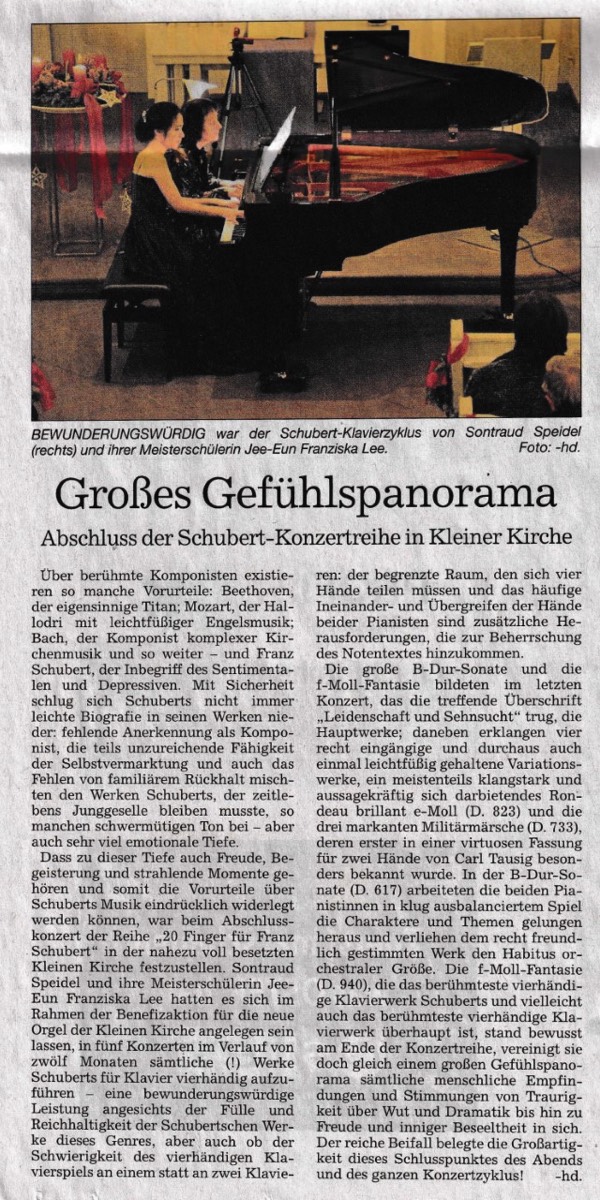 “There are many prejudices about famous composers: Beethoven, the headstrong titan; Mozart, the “Hallodin” with light-footed angelic music; Bach, the composer of complex church music and so on - and Franz Schubert, the epitome of the sentimental and depressive artist. Schubert's life which was not always easy, was certainly reflected in his works: lack of recognition as a composer, the sometimes inadequate ability to market himself, as well as the lack of family support added many a melancholic note into the works of Schubert who, due to circumstance, remained a bachelor throughout his life - but also a great deal of emotional depth.
That this depth also includes joy, enthusiasm and radiant moments, and thus the prejudices about Schubert's music can be clearly refuted, was evident at the final concert of the series "20 Fingers for Franz Schubert" in the nearly sold out “Kleine Kirche”. Sontraud Speidel and her master student Jee-Eun Franziska Lee had undertaken the task to perform all (!) of Schubert's works for piano for four hands in five concerts over the course of twelve months as part of the benefit campaign for the new organ in the “Kleine Kirche”. This was an admirable achievement in view of the abundance and richness of Schubert's works in this genre, but also due of the difficulty of playing piano four-hands on one piano instead of two: the limited space that hands have to share and the frequent interlocking and overlapping of the hands of both pianists are additional challenges that are added to the mastery of the musical scores.
The great B-flat major Sonata and the F minor Fantasy were the main works in the last concert which was aptly titled "Passion and Desire"; in addition there were four quite catchy and occasionally light-footed variation works, a mostly strong-sounding and expressive Rondeau brilliant in E minor (D. 823) and the three striking military marches (D. 733), the first of which became particularly well known in a virtuoso version for two hands by Carl Tausig. In the B-flat major Sonata (D. 617) the two pianists successfully worked out the characters and themes in cleverly balanced playing, giving the rather friendly-voiced work the disposition of orchestral grandeur. The Fantasy in F minor (D. 940), which is Schubert's most famous four-hand piano work and perhaps even the most famous four-hand piano work at all, was deliberately placed at the end of the concert series as it unites, like a great emotional panorama, all human feelings and moods, from sadness, anger and drama to joy and heartfelt emotion. The abundant applause proved the magnificence of the end of the evening and the whole concert cycle!“ -
07June
Badische Neueste Nachrichten on the CD „L'Heure Exquise"
"... The pianist's play combines clarity and many nuances of color, and she succeeds to create the large format in the Dutilleux as well as the Françaix sonata. The "Suite Française" as well as "Napoli Suite pour Piano" by Poulenc demand an lighter atmospheric approach with many nuances, which Franziska Lee copes masterfully on this CD. "location_on December 29, 2018 - Badische Neueste Nachrichten access_time 8:00 AM - 9:00 AMOn her first CD "L'Heure Exquise", the pianist Franziska Lee dedicated herself exclusively to French music of the 20th century. The student of Sontraud Speidel in Karlsruhe presents the sonatas of Henri Dutilleux and Jean Françaix, two piano suites by Francis Poulenc and a colorfull Toccata by Pierre Sancan. The wide dynamic spectrum of the Seoul-born pianist is captured very well by the recording technique, not only in the weighty Dutilleux Sonata of 1947-48, where the pianist's play combines clarity and many nuances of color, and she succeeds to create the large format in the Dutilleux as well as the Françaix sonata. The "Suite Française" as well as "Napoli Suite pour Piano" by Poulenc demand an lighter atmospheric approach with many nuances, which Franziska Lee copes masterfully on this CD. -
07June
Radio France Musique about the CD „L'Heure Exquise“
Broadcast „Actualité du disque : Françaix, ...“location_on June 11, 2018 Radio France „En Pistes“ access_time
By Rodolphe Bruneau-Boulmier and Emilie Munera
You have heard the prelude of the piano sonata by Jean Françaix, an excerpt from a sophisticated program presented by a musician in her first CD. It was published in the series "Portraits Premiere" of the label Capriccio, which offers to young artists the opportunity to publish their first recordings. This musician is Franziska Lee. The pianist was born in 1988 in Seoul and calls her CD "L'Heure Exquise", her CD is dedicated to our national repertoire. But not with the frequently recorded works by Debussy, Ravel, Faurée, which are so often heard here in the program. No, the pianist goes beyond and plays the works that are so often neglected by our pianists: works by Jean Françaix, Francis Poulenc, Pierre Sancan and Henri Dutilleux. She opens the CD with the Dutilleux Sonata for Piano, and she plays it very well, with a lot of energy and precision, you feel that she has no technical problems, which allows her to focus on everything else. She impressed me from the beginn until the end.
The CD is worthwhile because of its interpreter and and because of the program. Because you do not often hear the Sonata pour Piano by Jean Françaix, he wrote it for the pianist Idil Biret.
----- Music ----
Poulenc also plays a large part of the program on this CD, with his Suite Française, his trilogy Napoli, and Mélancolie, a small piece written in 1940 that is very typical of Poulenc, who, as always, surprises. I told you last Friday about the duality that is often found in the music of Poulenc. But this piece is aimed at the old and the new world, with its harmonies we are between Chopin and Debussy, but it is still Poulenc, played by Franziska Lee.
ORIGINAL
Le prelude de la Sonate pour Piano de Jean Françaix, un programme audacieux défendue par une musicienne dans c'est le premier disque dans la collection Premiere Portraits. C'est une collection du label Capriccio qui laisse la chance à des jeunes artistes d'enregistrer leur premier disque. Et donc cette musicienne elle s'appelle Franziska Lee, c'est une pianiste née à Séoul en 1988 et elle appele son disque de L'Heure Exquise, ca consacre à notre répertoire national mais pas avec les oevres les plus enregistrées, pas de Debussy, de Ravel, de Faurée comme on l'entend souvent dans ce jour de programme. Non la pianiste va plus loin et pioche dans sa répertoire parfois délaissé par nos musiciens avec des œuvres de Jean Françaix, Francis Poulenc Pierre Sancan et Henri Dutilleux. C'est la Sonate pour Piano de Dutilleux que ouvre le disque est qu'elle joue sacrément bien avec beaucoup d'énergie et de précision. On sent qu'elle n'a aucun problème technique, ce qui la permet de se consacrer évidemment sur tout le reste et elle m'a impressionné du début à la fin et vous-même Rodolphe - il y a quelque chose d'énergie, au début vous avez dit quelque chose il n'y a pas un problème technique.
Le disque vous avez compris vaut le coup pour l'interprete et pour le programme, puisqu'on entend pas souvent la Sonate pour Piano de Jean Françaix écrit pour Idil Biret. Poulenc pourqu'elle occupe une bonne partie aussi de ce programme avec sa Suite Française, sa trilogie Napoli et Mélancolie, une petite pièce ecrit en 1940 assez typique de Poulainc qui comme toujours surprend. J'en vous parlée a vendredi dernier de la dualité souvent de la musique de Poulenc, mais cette mélodie a fait appel à l'ancien et au nouveau monde dans ses harmonies nous sommes entre Chopin et Debussy mais c'est bien du Poulenc, joué par Franziska Lee.
----- Music ----
Mélancolie de Francis Poulenc, c'est joué par Franziska Lee, cette jeune artiste qui vient de Corée du Sud et ca s'appelle L'Heure Exquise. Cet extrait de cette collection Premier Portraits chez Capriccio, une collection consacrée aux jeunes musiciciens. On écoutera peut-être prochainement le premier mouvement de la sonate de Henri Dutilleux - avec plaisir - mais oui c'est tout lendemain dans cette emission - oui, et cest souvant un oevre que est jouée par des femmes - oui vous avez raison - femmes comme Geneviève Dutilleux, Marie-Catherine Girod, Claire-Marie Le Guay sont très nombreux d'avoir enregistrée cette sonate. Tu dois y avoir quelque chose qui qui plaît aux femmes dans cette magnifique sonate. -
07June
Two roses for the music
"It's worth every second to listen to the play of the pianist born in Seoul in 1988, and to watch it too: The piano is no longer played here, the piano is lived here ..."location_on by Claus-Dieter Hanauer
December 12, 2017 - Badische Neueste Nachrichten access_time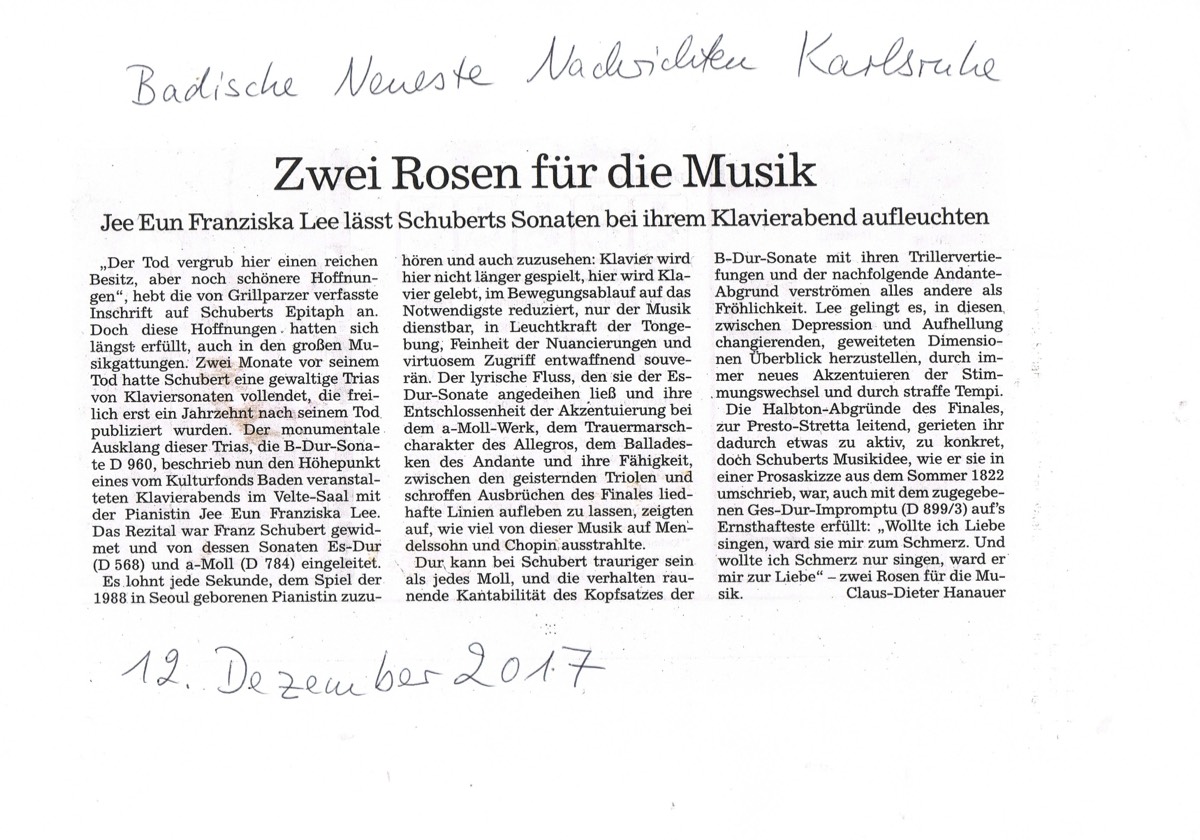 In her piano recital, Jee Eun Franziska Lee lights up Schubert's sonatas
"Death buries here a rich property, but even nicer hopes," emphasizes the inscription written by Grillparzer on Schuberts Epitaph. But these hopes have long come true, even in the major musical genres. Two months before his death, Schubert had completed a tremendous triad of piano sonatas, which were, however, published until a decade after his death. The monumental finale of this trio, the B flat major sonata D 960, described the climax of a piano evening organised by the Kulturfonds Baden in the Velte hall with the pianist Jee Eun Franziska Lee, dedicated to Franz Schubert and of his sonatas E flat major (D. 568) and A minor (D 784).
It's worth every second to listen to the play of the pianist born in Seoul in 1988, and to watch it too: The piano is no longer played here, the piano is lived here, the movement is reduced to the bare essentials, serving only to the music, in the luminosity of the sound, fineness of the nuances and virtuos access disarmingly sovereign. The lyrical flow she gave to the E flat major sonata and her determination to accentuate the A minor work, the funeral march character of the Allegro, the balladesque of the Andante, and her ability to create lyrical lines between the haunting triplets and ragged outbursts of the finale reveiled how much inspiration this music gave to Mendelssohn and Chopin.
In Schuberts music, Dur can be sadder than any minor, and the modestly murmuring cantabile of the first movement of the B-flat major sonata with its trillers and the subsequent Andante abyss exude everything but cheerfulness. Lee manages to gain an overview in these widening dimensions, alternating between depression and lightening, through ever new accentuation of mood changes and through tense tempi. The halftone abysses of the finale, leading to the Presto-Stretta, got a bit too active, too concrete, but Schubert's musical idea, as he described it in a prose sketch from the summer of 1822, was also complied by the encore, the G-sharp Major impromptu (D899 / 3) in the most serious way: "If I wanted to sing love, it became a pain for me. And if I only wanted to sing pain, it became love "- two roses for the music.
Claus-Dieter Hanauer -
07June
Outstanding culture of sound
Schubert pure: The pianist Jee-Eun Franziska Lee in the Alte Aulalocation_on by Klaus Roß
February 20, 2017 - Rhein-Neckar-Zeitung access_time 8:00 AM - 9:00 AM
Franz Schubert's pianistic sonata oeuvre has still not arrived yet in the concert business in all its diversity, despite famous advocats such as Alfred Brendel or Andras Schiff. Only a few late works are really present, pure Schubert-programmes extremely rare. The recital by Jee-Eun Franziska Lee at the Gesellschaft der Musik- und Kunstfreunde Heidelberg in the Alte Aula of the University with three sonatas from different creation periods of the composer, was all the more remarkable. The South Korean (born in 1988), trained by Sontraud Speidel among others, favoured classical clarity rather than romantic freedom in her Schubert performances, leaving the score speak for itself as unpretentious as it is.
His measured attitude was already good for the little-known early sonata B major D 575, whose cheerfully playful mood Jee-Eun Franziska Lee brought out very sparkling. The song-like E major Andante she shaped into a small lyrical jewel of touching simplicity and intimacy. A solitaire in this program. Also in the much more tart and dramatic A minor sonata D 784, the characteristically cantabile middle movement turned out to be a sensible centrepiece of the performance. Schubert's sheer orchestral passages of increase came from Jee-Eun Franziska Lee without any hardness or heaviness, a further proof of the outstanding sound culture of the Korean pianist currently studying at the Salzburg Mozarteum.
The highlight of the Heidelberg concert evening, however, was undoubtedly her astonishing maturity and sovereign interpretation of the great late A major Sonata D 959, which even did not have to shy away from prominent interpretation comparisons. Grandiosely wide-ranging the first movement, filled with symphonic breath. Far away from all larmoyance the subtly moving F-minor-Andantino. Feather-light the wonderfully enjoyable Scherzo, and truly enthusiastically exhilarating and in addition delicately nuanced the uniquely melodic final movement: Those who play works by Franz Schubert in such an animated and elegant way should find their place in the international piano world. Warm applause in the unfortunately only half-filled Alte Aula of the university. For the applause, the artist thanked with the wonderfully cantable interpreted Impromptu Gb major D 899/3. -
07June
... the playing of the Korean pianist Jee-Eun Franziska Lee was delightful.
Her impeccable technique is as admirable as the versatility of her musical expression.location_on by Klaus Günther
November 07, 1026 - Solinger Tageblatt access_time 8:00 AM - 9:00 AM
... The audience in the Meistermannsaal has been deeply impressed. For them, also the playing of the Korean pianist Jee-Eun Franziska Lee was a delightful experience. The young musician has already won numerous prizes at prestigious competitions. Her impeccable technique is as admirable as the versatility of her musical expression.
On Sunday she performed two piano concertos with the Dortmund Philharmonic, first the A minor Concerto by Clara Schumann (1819 - 1896). Clara's romantic love story with Robert Schumann is known thanks to several films. She began composing her concert at the age of thirteen and she played the world premiere in Leipzig at the age of sixteen. Conductor at that time: Felix Mendelssohn.
He is the composer of the Concerto in G minor, which Franziska Lee played at the end of the concert evening. While the pianist conjured up lyrical moods in the work of Clara Schumann, she thrilled with brilliance and virtuosity at the Mendelssohn concert. -
07June
Intimacy and maturity
Kulturfonds Baden honors JeeEun Franziska Leelocation_on by Christine Voigt
Badische Neueste Nachrichten - October 06, 2015 access_time 8:00 AM - 9:00 AM
The young pianist JeeEun Franziska Lee, who has now received the Music Prize of the Baden Cultural Fund, is not unknown in Karlsruhe. Born in 1988 in Seoul / South Korea, she first studied in her home country until she got the bachelor's degree. As a scholarship holder of the DAAD, she continued her studies from 2011 at the Karlsruhe University of Music. Since 2013 she teaches there as a student lecturer the compulsory subject piano. In the meantime, she has won a number of national and international competition prizes and already participates as a jury member in competitions.
She lead the award ceremony of the Cultural Fund in the Catholic Church Hohenwettersbach herself with the performance of Mendelssohn's "Fantasia" in F sharp minor op 28th. In deep inner sympathy she provided to the first part a colorful design with flowering technique, to the second she gave a friendly lovely face, and finally she inspired the listeners with the final Presto in souvereign technique with dynamic flexibility and elastic smoothness. After welcome words of the local head Elke Ernemann a dialogue took place between the young pianist and her teacher under the title "in the field of tension of the cultures" , where the young Korean showed a perfect integration and excellent German language skills. This discussion was followed by the presentation of the prize by Matthias Tritsch, President of the Cultural Fund.
Finally, Lee celebrated Beethoven's last Sonata No. 32 Op. 111 in C Minor, which is regarded as the legacy and culmination of his sonata work. Deeply immersed in the spirit of this music, she created, after a slow introduction in the fast first movement, exciting climaxes as well as clear contrasts. She presented the slow "Arietta" with a particularly soft touch and played it with deep intimacy and astonishing maturity. A wonderfully wide bow spread over this variation movement with all its contrasts, and the listeners reacted with deep emotion. -
07June
Tender and dynamic-powerful melodies
The South Korean Jee-Eun Franziska Lee has given a concert in the Simmozheimer Town Halllocation_on by Bettina Bausch
Schwarzwälder-Bote - November 11, 2014 access_time 8:00 AM - 9:00 AM(soon available in English)
Ihr Spiel ist zart und ausdrucksvoll und die Phrasierungen gestaltet sie mit großer Intimität. Jee-Eun Franziska Lee ist eine Ausnahmemusikerin und Meisterin ihres Faches. Denn was die junge Pianistin jetzt aus dem Flügel im Simmozheimer Rathaussaal geradezu herauszauberte, war Musik der Spitzenklasse.
Leicht vorgebeugt, immer auswendig und mit traumwandlerischer Sicherheit spielend, schien die Ausnahmekünstlerin mit dem Klavier geradezu verwachsen. Da war nichts von divenhaftem Gehabe zu spüren.
Hinter ihrem schlichten, freundlichen Auftreten verbirgt sich ein ungewöhnliches Musiktalent. Wer sie schon vor zweieinhalb Jahren an selber Stelle spielen hörte, merkte schnell, dass die Musikstudentin mit südkoreanischen Wurzeln inzwischen noch präziser, noch sicherer in der Interpretation, ja nahezu perfekt geworden ist.
Schon gleich mit dem ersten vorgetragenen Werk, Felix Mendelssohns Fantasie fis-moll op. 28, spielte sich die 26-Jährige in die Herzen der gespannt lauschenden Zuhörer. Das variationsreiche Stück mit fantasievollen Passagen ist in einer eher ungewöhnlichen Tonart geschrieben und verlangte hohe Konzentration sowie großes inneres Mitschwingen. Schon hier blitzte die Fähigkeit der jungen Musikerin zu ungewöhnlich sensibler Interpretation auf.
»Franz Schubert ist mein Lieblingskomponist«, bekannte sie lächelnd. Wohl auch deshalb stellte sie seine Klaviersonate in A-Dur in den Mittelpunkt des Abends. In den Sätzen Allegro, Andantino, Scherzo und Rondo, brannte die Meisterin der Tasten eine wahres Feuerwerk ihres Könnens ab. Zeigten die schnellen Sätze ihre fantastische Fähigkeit im virtuosen Spiel, so meisterte sie ruhigere Passagen mit großem Einfühlungsvermögen.
Höchstes Niveau erreichte Lee bei der Präsentation ihres dritten Werks, der Klaviersonate c-moll, op. 111 von Ludwig van Beethoven.
Im Allegro con brio ed appassionato wurde das typisch leidenschaftlich Entfesselte der Beethoven'schen Musik großartig herausgearbeitet Der Schlusssatz des Adagio molto mündete dann ein in eine ruhig-melodiös geprägte empfindsame Spielweise. Die zarte und immer wieder auch dynamisch-kraftvolle Art zu Spielen hatte restlos überzeugt.
Die Besucher des Abends waren erfasst worden vom meisterhaften Spiel der Musikstudentin, die bereits im Alter von fünf Jahren Klavierunterricht bekam und sich jetzt auf die Prüfung zur höchsten Stufe für Pianisten vorbereitet.
»Das war ganz, ganz toll«, resümierte Bürgermeister Hartmut Mayer. Er überreichte der Künstlerin unter begeistertem Applaus des Publikums ein Blumengebinde. Der Rathauschef kündigte an, das südkoreanische Genie am Flügel auf jeden Fall zu einem weiteren Konzert in die Gäugeeinde einzuladen. -
07June
Room-filling piano sound
Soloist exam of the pianist Jee-Eun Franziska Lee at the Musikhochschule Karlsruhelocation_on Badische Neueste Nachrichten, hd - July 08, 2014 access_time 8:00 AM - 9:00 AM
Most public recitals of the Soloist Examina at conservatoires have one thing in common: The selection of the standardized, classical-romantic piano repertoire; sadly, "slips" into the Baroque era or even into the 20th century are rare here. However, this can not be said about the program chosen by Pianist Jee-Eun Franziska Lee, born in Seoul, Korea in 1988, who has been studying with Sontraud Speidel since 2011 at the Musikhochschule Karlsruhe and now for over a year in the study course Soloist Exams: She combied Schuberts late A major Sonata D. 959, which even "established" pianists dread, with the Piano Sonata of the French composer Henri Dutilleux, deceased 2013, and betrayed by that even before the first sound was heard the artistically individual approach of Jee-Eun Franziska Lee, with which she presented her soloist exam recital in Velte Saal of Schloss Gottesaue.
With her truly room-filling orchestral, sustainably sonorous piano sound and the intellectual penetration of the formal arrangement of the first movement in Schubert's sonata, Lee clearly showed her artistic maturity and intelligence. In the following Andantino, the exact perseverance of the tempo, without much yielding, expressed Schubert's typical wanderer-like character while avoiding unnecessary sentimentality. Extremely impressive was here the wild, inexorably designed "thunderstorm" in the center of the movement.
With the scherzo played with serene wit and the concluding, adequately fast paced rondo, Lee finally led to Henry Dutilleux's piano sonata, proving her great technical and physical as well as her creative power of her playing. She succeeded in capturing the many characters of the often shimmering, erring light to form a work with sometimes almost jazzy echoes into a large ensemble, while she always articulated precisely. In the sometimes slow second and third movement, she clearly emphasized the melody-leading voices and, in other complex and fast passages, put the virtuosity required here entirely into the service of the work.
The audience was extremely impressed and enthusiastic about the play of this pianist, whom we wish a great publicity in future. -
07June
Depth of feeling
Jee-Eun Franziska Lee in the Villa Wieser with Zontalocation_on Rheinpfalz Zeitung, wtz - September 14, 2013 access_time 8:00 AM - 9:00 AM
The South Korean pianist Jee-Eun Franziska Lee offered a brilliant concert at Zonta Club Landau-Südpfalz on Saturdayin the Villa Wieser. She impressed by imposing performances of highly sophisticated works by Scarlatti, Beethoven and Scriabin.
The petite young woman, who focused on the first few bars of a Scarlatti sonata with a confident calm, showed already in her gesture a complete devotion to the music. She brilliantly developed the vocal lines of the lyric F minor Sonata (K, 481) as well as the clear contours of the animated Sonata in D minor (K.1).
Also in the rapid performance of the Chopin Etude in F major, op. 10, the pianist convinced with her sophisticated technique and touch culture. In the performance of the ingenious paraphrase of Isoldes love death from Wagner's opera by Franz Liszt, she proved that she prefers colorful playing . This reveals a deeply romantic world of sound, which demands orchestral sonority as well as colorful dynamics from the performer. Lee flawlessly played the virtuoso sound cascades, confidently modeling the themes out of harmonic events. Decisive were her emotional depth and passion, which she also expressed in her imaginative interpretation of the second Sonata in G sharp minor op. 19 by Scriabin.
But the highlight of the concert was her interpretation of Beethoven's last Piano Sonata No. 32 in C minor. This large work is one of the most expressive works of Beethoven. It demands a confession of the interpreter to his music, it has become the touchstone of all great pianists. Jee-Eun Franziska Lee interpreted the work with enormous energy and power, placing emphasis on the contrasting orchestral effect. Her view of the passionate Allegro movement impressed by powerful dynamics. In the variations of the Arietta, a songlike adagio, the pianist developed the tender sound structures with expression and rhythmic precision.
In Seoul, Jee-Eun Franziska Lee graduated 2011 with a bachelor's degree as best student of the year. After competition successes in Korea and Vienna, she began her Master's degree in 2011 at the Musikhochschule Karlsruhe with Sontraud Speidel supported by the German Academic Exchange Service. The young pianist has proven her skills in numerous concerts, and the concert evening for Zonta was a further proof of her ambitious art.
Imprint
Owner
Jee Eun Franziska Lee
E-Mail: mail@franziskalee.com
Copyright
All rights reserved. Any reproduction or redistribution in any medium in whole or in part requires the written consent of the site owner. We dissociate ourselves from any content of the websites to which this website refers.
Copyright © 2019 Jee Eun Franziska Lee, all rights reserved.
Disclaimer
Liability for contents
As a service provider, we are responsible for our own content on these pages in accordance with the general laws pursuant to § 7 para. 1 TMG. However, according to §§ 8 to 10 TMG, we are not obligated as a service provider to monitor transmitted or stored third-party information or to investigate circumstances that indicate illegal activity.
Obligations to remove or block the use of information under the general laws remain unaffected. However, liability in this regard is only possible from the point in time at which a concrete infringement of the law becomes known. If we become aware of any such infringements, we will remove this content immediately.
Liability for links and YouTube
Our offer contains links to external websites of third parties, on whose contents we have no influence. Therefore, we cannot assume any liability for these external contents. The respective provider or operator of the pages is always responsible for the content of the linked pages. The linked pages were checked for possible legal violations at the time of linking. Illegal contents were not recognizable at the time of linking.
However, a permanent control of the contents of the linked pages is not reasonable without concrete evidence of a violation of the law. If we become aware of any infringements, we will remove such links immediately.
YouTube videos are linked on our website via external links. You as a user will leave our website when playing these videos and will be redirected to YouTube.
Copyright
The content and works created by the site operators on these pages are subject to German copyright law. Duplication, processing, distribution, or any form of commercialization of such material beyond the scope of the copyright law shall require the prior written consent of its respective author or creator. Downloads and copies of this site are only permitted for private, non-commercial use.
Insofar as the content on this site was not created by the operator, the copyrights of third parties are respected. In particular, third-party content is identified as such. Should you nevertheless become aware of a copyright infringement, please inform us accordingly. If we become aware of any infringements, we will remove such content immediately.
Privacy policy
1. Data protection
General information
The following notices provide a simple overview of what happens to your personal data when you visit this website. Personal data is any data by which you can be personally identified. For more detailed information on data protection, please refer to our privacy policy listed below this text.
Data collection on this website
Who is responsible for data collection on this website?
Data processing on this website is carried out by the website operator. You can find his contact details in the section "Note on the responsible party" in this data protection declaration.
How do we collect your data?
IOn the one hand, your data is collected by you providing it to us. This may, for example, be data that you enter in a contact form. Other data is collected automatically or after your consent when you visit the website through our IT systems. This is mainly technical data (e.g. Internet browser, operating system or time of page view). This data is collected automatically as soon as you enter this website.
What do we use your data for?
Part of the data is collected to ensure error-free provision of the website. Other data may be used to analyze your user behavior.
What rights do you have regarding your data?
You have the right at any time to receive information free of charge about the origin, recipient and purpose of your stored personal data. You also have a right to request the correction or deletion of this data. If you have given your consent to data processing, you can revoke this consent at any time for the future. You also have the right to request the restriction of the processing of your personal data under certain circumstances. Furthermore, you have the right to lodge a complaint with the competent supervisory authority. For this purpose, as well as for further questions on the subject of data protection, you can contact us at any time.
2. Hosting und Content Delivery Networks (CDN)
Externes Hosting
This website is hosted by an external service provider (hoster). The personal data collected on this website is stored on the hoster's servers. This may include, but is not limited to, IP addresses, contact requests, meta and communication data, contract data, contact details, names, website accesses and other data generated via a website.
The hoster is used for the purpose of fulfilling contracts with our potential and existing customers (Art. 6 para. 1 lit. b DSGVO) and in the interest of a secure, fast and efficient provision of our online offer by a professional provider (Art. 6 para. 1 lit. f DSGVO).
Our hoster will only process your data to the extent necessary to fulfill its service obligations and follow our instructions regarding this data.
We use the following hoster:
One.com Group AB
Carlsgatan 3
211 20 Malmö
Sweden
3. General notes and obligatory information
Data protection
The operators of these pages take the protection of your personal data very seriously. We treat your personal data confidentially and in accordance with the statutory data protection regulations and this data protection declaration.
When you use this website, various personal data are collected. Personal data is data with which you can be personally identified. This privacy policy explains what data we collect and what we use it for. It also explains how and for what purpose this is done.
We would like to point out that data transmission on the Internet (e.g. when communicating by e-mail) can have security gaps. Complete protection of data against access by third parties is not possible.
Note on the responsible entity
The responsible party for data processing on this website is:
Jee Eun Franziska Lee
e-mail: franziska-lee@web.de
The responsible party is the natural or legal person who alone or jointly with others determines the purposes and means of the processing of personal data (e.g. names, e-mail addresses or similar).
Storage period
Unless a more specific storage period has been stated within this privacy policy, your personal data will remain with us until the purpose for processing the data no longer applies. If you assert a legitimate request for deletion or revoke your consent to data processing, your data will be deleted unless we have other legally permissible reasons for storing your personal data (e.g. retention periods under tax or commercial law); in the latter case, the data will be deleted once these reasons no longer apply.
Note on data transfer to the USA
Among other things, tools from companies based in the USA are integrated on our website. If these tools are active, your personal data may be transferred to the US servers of the respective companies. We would like to point out that the USA is not a safe third country in the sense of EU data protection law. US companies are obliged to hand over personal data to security authorities without you as a data subject being able to take legal action against this. It can therefore not be ruled out that US authorities (e.g. intelligence services) process, evaluate and permanently store your data located on US servers for monitoring purposes. We have no influence on these processing activities.
Revocation of your consent to data processing
Many data processing operations are only possible with your express consent. You can revoke consent you have already given at any time. The legality of the data processing carried out until the revocation remains unaffected by the revocation.
Right to object to the collection of data in special cases as well as to
Direct advertising (Art. 21 DSGVO)
IF THE DATA PROCESSING IS BASED ON ART. 6 ABS. 1 LIT. E OR F DSGVO, YOU HAVE THE RIGHT TO OBJECT TO THE PROCESSING OF YOUR PERSONAL DATA AT ANY TIME FOR REASONS ARISING FROM YOUR PARTICULAR SITUATION; THIS ALSO APPLIES TO PROFILING BASED ON THESE PROVISIONS. THE RESPECTIVE LEGAL BASIS ON WHICH PROCESSING IS BASED CAN BE FOUND IN THIS PRIVACY POLICY. IF YOU OBJECT, WE WILL NO LONGER PROCESS YOUR PERSONAL DATA CONCERNED UNLESS WE CAN DEMONSTRATE COMPELLING LEGITIMATE GROUNDS FOR THE PROCESSING WHICH OVERRIDE YOUR INTERESTS, RIGHTS AND FREEDOMS, OR THE PROCESSING IS FOR THE PURPOSE OF ASSERTING, EXERCISING OR DEFENDING LEGAL CLAIMS (OBJECTION UNDER ARTICLE 21(1) DSGVO). IF YOUR PERSONAL DATA ARE PROCESSED FOR THE PURPOSE OF DIRECT MARKETING, YOU HAVE THE RIGHT TO OBJECT AT ANY TIME TO THE PROCESSING OF PERSONAL DATA CONCERNING YOU FOR THE PURPOSE OF SUCH MARKETING; THIS ALSO APPLIES TO PROFILING INSOFAR AS IT IS RELATED TO SUCH DIRECT MARKETING. IF YOU OBJECT, YOUR PERSONAL DATA WILL SUBSEQUENTLY NO LONGER BE USED FOR THE PURPOSE OF DIRECT MARKETING (OBJECTION PURSUANT TO ARTICLE 21 (2) DSGVO).
Right of appeal to the competent supervisory authority
In the event of violations of the GDPR, data subjects shall have a right of appeal to a supervisory authority, in particular in the Member State of their habitual residence, their place of work or the place of the alleged violation. The right of appeal is without prejudice to any other administrative or judicial remedy.
Right to data portability
You have the right to have data that we process automatically on the basis of your consent or in performance of a contract handed over to you or to a third party in a common, machine-readable format. If you request the direct transfer of the data to another responsible party, this will only be done insofar as it is technically feasible.
SSL or TLS encryption
For security reasons and to protect the transmission of confidential content, such as orders or requests that you send to us as the site operator, this site uses SSL or TLS encryption. You can recognize an encrypted connection by the fact that the address line of the browser changes from "http://" to "https://" and by the lock symbol in your browser line.
If SSL or TLS encryption is activated, the data you transmit to us cannot be read by third parties.
Information, deletion and correction
Within the framework of the applicable legal provisions, you have the right at any time to free information about your stored personal data, its origin and recipient and the purpose of data processing and, if necessary, a right to correction or deletion of this data. For this purpose, as well as for further questions on the subject of personal data, you can contact us at any time.
Right to restriction of processing
You have the right to request the restriction of the processing of your personal data. For this purpose, you can contact us at any time. The right to restriction of processing exists in the following cases:
a) If you dispute the accuracy of your personal data stored by us, we usually need time to verify this. For the duration of the verification, you have the right to request the restriction of the processing of your personal data.
b) If the processing of your personal data has happened/is happening unlawfully, you can demand the restriction of data processing instead of deletion.
c) If we no longer need your personal data, but you need it to exercise, defend or enforce legal claims, you have the right to request the restriction of the processing of your personal data instead of erasure.
d) If you have lodged an objection pursuant to Art. 21 (1) DSGVO, a balance must be struck between your interests and ours. As long as it has not yet been determined whose interests prevail, you have the right to request the restriction of the processing of your personal data.
If you have restricted the processing of your personal data, this data may - apart from being stored - only be processed with your consent or for the assertion, exercise or defense of legal claims or for the protection of the rights of another natural or legal person or for reasons of an important public interest of the European Union or a Member State.
4. Data collection on this website
Cookies
Our internet pages use so-called "cookies". Cookies are small text files and do not cause any damage to your terminal device. They are stored either temporarily for the duration of a session (session cookies) or permanently (permanent cookies) on your end device. Session cookies are automatically deleted at the end of your visit. Permanent cookies remain stored on your end device until you delete them yourself or until they are automatically deleted by your web browser.
In some cases, cookies from third-party companies may also be stored on your terminal device when you enter our site (third-party cookies). These enable us or you to use certain services of the third-party company (e.g. cookies for processing payment services).
Cookies have various functions. Many cookies are technically necessary, as certain website functions would not work without them (e.g. the shopping cart function or the display of videos). Other cookies are used to evaluate user behavior or display advertising.
Cookies that are necessary to carry out the electronic communication process (necessary cookies) or to provide certain functions that you have requested (functional cookies, e.g. for the shopping cart function) or to optimize the website (e.g. cookies to measure the web audience) are stored on the basis of Art. 6 (1) lit. f DSGVO, unless another legal basis is specified. The website operator has a legitimate interest in storing cookies for the technically error-free and optimized provision of its services. If consent to the storage of cookies has been requested, the storage of the cookies in question is based exclusively on this consent (Art. 6 para. 1 lit. a DSGVO); consent can be revoked at any time.
You can set your browser so that you are informed about the setting of cookies and only allow cookies in individual cases, exclude the acceptance of cookies for certain cases or in general and activate the automatic deletion of cookies when closing the browser. If cookies are deactivated, the functionality of this website may be limited.
Insofar as cookies are used by third-party companies or for analysis purposes, we will inform you separately about this within the framework of this data protection declaration and, if necessary, request your consent.
Source: www.e-recht24.de